Reverse percentages: finding the original price from the sale price
By Today Offers Journal · Sep 15, 2026 · 4 min read
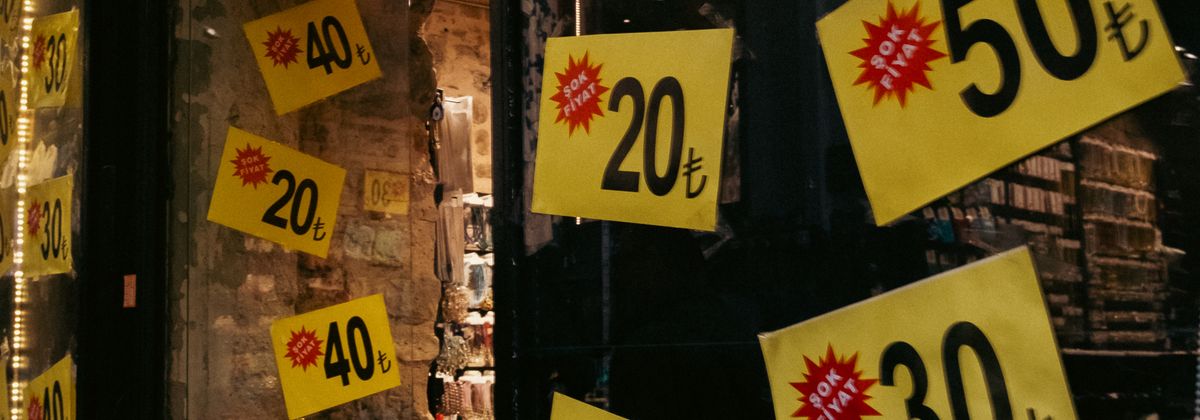
Sometimes you only see the sale price and the percentage off. This guide shows how to work backwards to the original price, and why subtracting the percentage gets it wrong.
Most percentage questions go forward: you know the original price and the discount, and you want the final price. Reverse percentages go the other way. You see a sale price and a percentage off, and you want to know what the item cost before the reduction. This is useful for checking claims, estimating a regular price and spotting deals that are weaker than they look.
The common mistake
Say a coat is on sale for $63 and the sign says 30% off. A natural shortcut is to add 30% to $63. Thirty percent of $63 is $18.90, so the "original" would be $81.90.
That answer is wrong. The 30% was taken off the original price, not off $63. The sale price is the remaining 70% of the original, so you need to scale up from there.
The correct method
If the discount is D percent, the sale price equals the original multiplied by (100 minus D) divided by 100. To undo it, divide the sale price by that decimal.
For the coat:
- 100 minus 30 is 70, so the sale price is 70% of the original.
- As a decimal, 70% is 0.70.
- Divide $63 by 0.70 to get $90.
The original price was $90. Check it: 30% of $90 is $27, and $90 minus $27 is $63. The numbers agree.
A reference table for common cases
Dividing by a decimal is awkward in your head, so here are shortcuts for common percentages.
- 10% off: the sale price is 9/10 of the original. Divide by nine and multiply by ten.
- 20% off: the sale price is 4/5 of the original. Divide by four and multiply by five.
- 25% off: the sale price is 3/4. Divide by three and multiply by four.
- 50% off: the original is double the sale price.
- 75% off: the sale price is 1/4, so the original is four times the sale price.
For 25% off a sale price of $54, divide 54 by three to get 18, then multiply by four to get $72. That is the original.
The chart shows why the percentage matters. A $60 sale price is a small bargain if the original was $66.67, and a big one if it was $120. The same final price tells you very little until you know the claim behind it.
When this is useful
Working backwards helps in several everyday situations.
- Checking a headline claim. If a sign says "was $200, now $120, 40% off", you can confirm that $120 divided by 0.60 is $200. The claim is consistent.
- Finding an inconsistency. If the sign says 40% off but the "was" price is $240, the numbers do not match. One of them is wrong or describes something else.
- Estimating a regular price. You see a "now $45, 25% off" tag with no "was" price. Dividing by 0.75 gives $60, which you can compare with other sellers.
- Reading receipts. A receipt may show only the discounted price and the percentage. You can recover the original for your records or returns.
What about tax and extra discounts?
Reverse percentages work on prices that share the same basis. If the sale price includes tax and the original did not, the answer will be off. Make sure both sides use the same convention.
If two discounts were stacked, undo them together using the multiplication trick. For 50% then 20%, the final price is 40% of the original, so divide by 0.40. A $32 final price implies an original of $80. You can read more about the multiplication method in the article on combined percentages in the Journal.
Spot-check examples
Try these on paper to build confidence.
- A bike helmet is $44.10 after 30% off. Original: 44.10 divided by 0.70 is $63.
- A kettle is $36 after 20% off. Original: 36 divided by 0.80 is $45.
- A desk lamp is $27 after 10% off. Original: 27 divided by 0.90 is $30.
- A pair of boots is $105 after 25% off. Original: 105 divided by 0.75 is $140.
In each case the original is higher than the "add the percentage on" shortcut would suggest.
Cross-checking with a second source
Working backwards gives you the implied original price. It does not tell you whether anyone actually sold the item at that price. Treat the answer as a hypothesis, then test it. Look at what other sellers charge, check previous flyers, or compare with a price you have paid. If your calculated original is close to what you see elsewhere, the discount is probably real. If it is much higher than any price you can find, the sale price may be fair but the percentage is not telling you the whole story.
Keep it simple
The whole method is one sentence: divide the sale price by what remains after the discount. Say it once or twice and you will be able to recover an original price in a few seconds, with a calculator or without.
Frequently asked questions
Why can't I just add the percentage back onto the sale price?
Because the percentage was taken from the original price, which is larger. Adding it back to the smaller sale price underestimates the original.
What is the formula for the original price?
Divide the sale price by the share you still pay as a decimal. For 30% off, divide by 0.70.
Does this work with coupons as well as sale tags?
Yes, for percentage coupons. A fixed-dollar coupon is simpler: add the dollar amount back to the price you paid.
Ready to put this to use? Browse today's offers Share a deal you found
 How to tell a real discount from a fake one
 How to evaluate buy-one-get-one, bundles and multi-buy offers
 Ten phrases in offer terms translated: subject to availability, at participating stores and more