Five sale tags checked step by step: worked examples
By Today Offers Journal · Nov 14, 2026 · 4 min read
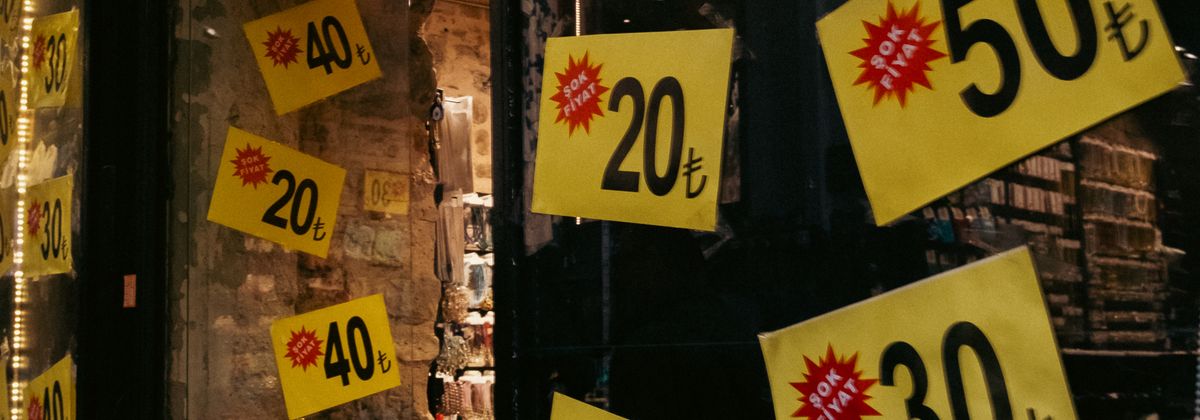
Five realistic-looking sale tags, each checked with simple arithmetic. See how to catch a mismatched percentage, a weak comparison, a tricky multi-buy and a shrunken pack.
Rules are easier to remember when you have used them. Here are five sale tags, all invented for practice, with the kind of wording you might see in a shop or on a screen. For each, we will check the claim with the simplest maths that gets the job done. Prices are examples only, and real offers vary.
Tag 1: "Was $90, now $63, save 40%"
The claim has three numbers, so they should agree.
- Saving: 90 minus 63 is $27.
- Percentage: 27 divided by 90 is 0.30, or 30%.
- The tag says 40%, but the prices show 30%.
What happened? Possibly the 40% belongs to an earlier price, or to a different version of the item, or it is simply an error. The honest reading is that you save 30% against the "was" price. Whether that is a good deal depends on what the item normally costs elsewhere. The lesson: when numbers on one tag disagree, trust the prices and ask about the rest.
Tag 2: "Extra 25% off already reduced items" on a $48 tag
The tag price is $48, after an earlier markdown. The extra discount applies to that price.
- You pay 75% of $48, which is 48 times 0.75.
- That is $36.
Suppose the original price was $80, so the $48 tag was already 40% off. Combined discounts multiply: 0.60 times 0.75 is 0.45, so you pay 45% of the original, $36, and save 55% in total. It is not 65%, which is what you would get by adding 40% and 25%. The final price, $36, is the number to judge.
Tag 3: "3 shirts for $60, usually $24 each"
This is a multi-buy offer.
- Regular price for three: 3 times $24 is $72.
- Offer price: $60.
- Saving: $12, which is 12 divided by 72, or about 16.7%.
- Price per shirt: $20.
The deal is real if you would buy three shirts. If you only want two, two at the regular price cost $48, which is less than $60, so the offer wins only when you take all three. And if another seller sells the same shirt at $18 every day, three cost $54 there, and the "deal" is no longer the cheapest.
Tag 4: "Bigger savings! Now $9.60, was $12.00"
The product is detergent. The tag says $9.60 for the same bottle you bought last month for $12.00. That is a saving of $2.40, or 20%.
But the bottle now says 1.5 L, and last month's said 2 L. The quantities matter.
- Last month: $12.00 for 2 L is $6.00 per litre.
- Today: $9.60 for 1.5 L is $6.40 per litre.
The "sale" costs more per litre. You pay less per bottle but more per wash. The difference is small, about 7%, but it points the wrong way. See the guide to shrunken packs in the Journal for more on this check.
Tag 5: "Headphones $120, save $36 with code, free shipping over $75"
The pieces here are a price, a code and a shipping rule.
- Price: $120.
- Code: minus $36, so $84.
- Shipping: the order is over $75 before the code, but check whether the threshold counts the price after the code. If it counts the discounted total, $84 is still over $75, so shipping is free. If the code lowered the total below the threshold, shipping would be charged.
- Tax: add what applies in your area.
The discount is 36 divided by 120, which is 30%. The final price is $84 plus tax, with free shipping. You can then compare it with other sellers' final prices. Browse the offers in your area to see whether anyone beats it.
What the five examples share
Each check used the same short sequence.
- Do the numbers on the tag agree with each other?
- What is the final price I will pay?
- How does it compare with the quantity and the usual price?
- Do any conditions change the maths?
The method matters more than the particular tags. Once you have done it a handful of times, you will do it quickly.
Try it yourself
Take a flyer or a product page and pick three offers. For each one, write down the final price, the percentage saved and the price per unit if it applies. Compare your notes with what the headline claims. If they match, you have found honest tags. If they do not, you have found something to ask about.
The takeaway
A tag is a bundle of claims, and each claim can be tested with a line or two of arithmetic. You do not need to be a maths expert. You need a habit: translate the offer into a final price and a fair comparison, then decide. The more you practise, the less any sign can surprise you.
Frequently asked questions
What should I do if the percentage on a tag does not match the prices?
Calculate the percentage from the two prices and trust that figure. You can ask staff or check the terms to see what the stated percentage refers to.
How do I check a multi-buy offer?
Compare the offer price with the regular price for the same quantity, then compare the price per item with the price for the number you actually need.
Why check the quantity on a "sale" product?
The pack may have changed size. Dividing the price by the amount shows whether the unit price really fell.
Ready to put this to use? Browse today's offers Share a deal you found
 How to tell a real discount from a fake one
 How to evaluate buy-one-get-one, bundles and multi-buy offers
 Ten phrases in offer terms translated: subject to availability, at participating stores and more